|
|
|
|
|
|
|
|
|
|
|
|
|
|
|
|
|
|
Air of Authority - A History of RAF Organisation
|
|
|
|
|
|
|
|
|
|
|
|
|
|
|
|
|
|
This section will give brief histories of those ground training units providing initial or advanced training to officers: -
RAF School of Aeronautical Engineering (Officers)
This was formed by September 1938 at Henlow and expanded to form the RAF Technical College on 15 August 1947.
Advanced Armament Course
This was formed at Fort Halstead, Kent on 1 April 1943 to provide training to officers in the highly specialised duties involved in armament development and research work. Each course was for a duration of nine months with an intake of 12 officers, although the first course commencing on 3 May 1943, only comprised 6 students.
Air Crew Officers School/No 1 Air Crew Officers School
This was formed on 1 April 1943 under the control of No 54 Group at Sidmouth. Its purpose was to provide training in leadership, law, administration and defence to aircrew officers at PRCs and aircrew officers trained at home. The course was of 3 week's duration with a weekly intake of 140 officers.
It was transferred to No 22 Group on 6 December, at which point it had a peak capacity of 360 on a four week course. On 19 January 1944 it moved to Hereford, although work at that station was incomplete so was only able to accommodate half of the planned capacity of 1,500. Therefore from 8 February 1944 to 19 May it operated No 2 Wing at RAF Filey Camp, which provided accommodation for the other 750. On 1 November 1944 it was retitled No 1 Air Crew Officers' School and was redesignated No 1 Officers' School on 1 May 1946.
No 2 Air Crew Officers School
The nucleus of this unit formed on 1 November 1944 at No 22 PTC, Almaza under the control of No 203 Group. It moved to Ramat David shortly afterwards and then to Gaza before the end of November, where it was transferred to AHQ Levant
It ran courses of 4 week's duration for 60 pupils per course and disbanded on 16 February 1946.
No 3 Air Crew Officers School
This was formed on 1 December 1944 at No 56 PTC, Naples under the operational control of HQ MAAF and administered by HQ MACAF. It ran courses of 4 week's duration for 60 pupils per course, moving to Sulmona in 1945 and disbanded on 6 October 1945.
Aircrew Officer Training School
This was formed on 1 January 1967 at South Cerney, under the control of No 25 Group. It moved to Church Fenton on 21 January 1968, where it absorbed the Primary Flying Squadron but absorbed into OCTU at Henlow.
No 76 Air School
This was formed in May 1941 at Voortrekkerhoogte but disbanded in July, its role being taken over by the Military College.
Civilian Supply and Technical Officers School
This was formed as part of the establishment of RAF Bicester on 3 September 1951, but was reformed as a separate unit in No 40 Group on 1 April 1952, no further details at present..
Defence Academy of the UK
Defence College of Aeronautical Engineering
Defence Leadership Centre
Home Command Modified Officer Cadet Training Unit
This was formed from in January 1953 at Hawarden, moving to Booker on 1 June 1956 but its fate is unknown.
Imperial Defence College
Schools of Instruction were retitled
No 1 School of Instruction
This was formed on 20 December 1915 at the Co-operative Wholesale Society Jam Works, Reading, becoming an independent station on 1 July 1916. On 27 October 1916 it was retitled No 1 School of Military Aeronautics and then No 1 School of Aeronautics on 1 April 1918 and disbanded on 24 January 1919.
No 2 School of Instruction
This was formed on 3 April 1916 at Christchurch College, Oxford, becoming an independent station on 1 July 1916. On 27 October 1916 it was retitled No 2 School of Military Aeronautics and then No 2 School of Aeronautics on 1 April 1918 and disbanded on 24 January 1919.
No 3 School of Military Aeronautics
This was formed from the Technical Training Class on 25 November 2016 at Aboukir, moving to Abbassia on 15 February 1917 and then to the Palace Hotel in Heliopolis in October. On 1 April 1918 it was retitled No 3 School of Aeronautics and disbanded on 22 July 1919.
No 4 School of Military Aeronautics
This was formed on 1 July 1917 at Toronto. On 1 April 1918 it was retitled No 4 School of Aeronautics and disbanded on in March 1919.
No 5 School of Military Aeronautics
This was formed out of No 2 SoMA on 1 August 1917 at Christchurch College, Oxford, moving to Denham on 8 September1917. On 1 April 1918 it was retitled No 5 School of Aeronautics and disbanded on 15 February 1919.
No 6 School of Military Aeronautics
This was formed out of No 5 SoMA on 1 November 1917 at Denham, moving to 10 Elmdale Road, Clifton, Bristol on 23 January 1918. On 1 April 1918 it was retitled No 6 School of Aeronautics and disbanded on 24 January 1919.
No 7 (Observers) School of Military Aeronautics
This was formed on 14 January 1918 at 21 Poultney Street, Bath, moving to 19 The Circus, Bath on 18 March 1918. On 1 April 1918 it was retitled No 7 School of Aeronautics and by October was at the Francis Hotel, Bennett Street, Bath. It finally and disbanded on 4 April 1919.
No 8 School of Aeronautics
This was formed on 17 July 1918 at Municipal Buildings, Cheltenham, later moving to Marlborough House, also in Cheltenham. On 14 November 1918 it moved to St Martin's Field Camp at Shorncliffe and disbanded on 24 January 1919.
No 9 (Observers) School of Aeronautics
This was formed from No 7 Observers Cadet Wing on 23 September 1918 at Wantage Hall, Reading, moving to Cheltenham on 26 October 1918 and disbanded on 24 January 1919.
School of Instruction, Hendon
This was formed on by 1916 at Hendon, coming under the control of the Officer Commanding, 18th Wing on 22 September and disbanded on 12 October 1918.
School of Instruction, Southern Training Brigade
This was formed from on in October 1917 at Beaulieu, moving to Old Sarum in early 1918 and then to Andover on 10 June, where it disbanded on 22 June 1918.
Joint
Services Command and Staff College
Joint
Services Defence College
Joint Services Staff College
Junior Commanders Course
This was formed on 3 August 1943 at Dallachy under the control of No 21 Group, administered by RAF Banff. It was designed to provide training in leadership and administration for junior officers who were considered to be suitable for employment as Flight and Squadron commanders. The course was of two weeks duration, with an initial intake of 50 per fortnight, later rising top 100 per fortnightly.
Middle East Centre for Arab Studies
This was a joint service unit opened in Jerusalem in early 1946, which was announced in AMO A414/46 of 16 May 1946.
No further details at present.
Middle East Officers School of Administration
This was formed at Amman on 13 September 1946 to run the following courses: -
Officers Advanced Training Course
Officers Basis Course in RAF Administration
It was operationally controlled by HQ RAF MedME and administered by AHQ Levant, and disbanded on 24 October 1947.
RAF Wing, Middle East Staff School
RAF Wing, Middle East Staff College
National
Defence College
Officer Cadet Training Unit
This was formed on 1 May 1946 at Cosford, with a capacity of 240 and it it moved to Spittlegate on 25 February 1948, where it was redesignated No 2 OCTU after 1948.
No 2 Officer Cadet Training Unit
This was formed from the OCTU after 1948 at Spittlegate (later renamed Spitalgate), being transferred from No 22 Group to No 24 Group on 1 March 1954 and closed on 25 March 1954.
Officer Cadet Training Unit
This was formed on 7 November 1942 at Amman, to train officers for the RAF Regiment and was redesignated No 3 Officers' and Cadets' Training School on 15 August 1944.
Officer Cadet Training Unit
This was formed on 1 September 1952 at Millom in No 22 Group, as an addition to the OCTU at Spitalgate and disbanded on 10 September 1953, with its commitment being transferred to RAF OCTU (Jurby).
However, it was re-established at Millom on 12 October 1953 as RAF Station Millom and placed on Care and Maintenance on 1 June 1954.
RAF Officer Cadet Training Unit
This was formed on 10 September 1953 at Jurby in No 22 Group, as RAF OCTU (Jurby) but was simply retitled RAF OCTU on 1 April 1954. On 3 January 1962 it absorbed the WRAF OCTU from Hawkinge and moved to Feltwell on 1 September 1963. Its final move was to Henlow on 1 May 1966 where control was transferred to HQ Training Command and disbanded on 24 April 1980 with all officer training moving to Cranwell.
The Officers Advanced Training School/No 1 Officers Advanced Training School
This began forming on 14 February 1944 at Cranwell as The Officers' Advanced Training School, opening on 1 March to deliver the following: -
The Senior Commanders' Course
For potential Station Commanders of all Branches in the principles of organisation and administration of a RAF Station, with a capacity of 15 on a 4 week course.
The Junior Commanders' Course
For potential Flight and Squadron Commanders in administration and leadership, with a capacity of 200 on a 2 to 3 week course.
It was re-named No 1 OATS on 1 November 1944 Its role was to provide training to officers destined for flight and squadron commander posts. It moved to Digby on 27 August 1945 reverting to its original title on 1 December 1946. Further moves took place to Hornchurch from 25 June 1947 and Bircham Newton on 11 October 1948, where it was absorbed into the RAF School of Administration on 1 June 1951 and disbanded in 1962
1 Mar 1944 A/Cdre S H Hardy
23 Jun 1945 A/Cdre T G Pike
xx xxx 1947 A/Cdre A McKee
The following Air Ministry Orders applied to this unit: -
No 1 Officers' Advanced Training School
No 1 Officers' Advanced Training School, which is located at RAF Station, Digby, will continue to provide the undermentioned training facilities at least until the end of 1946: -
The Senior Commanders' Course duration four weeks.
The Junior Commanders' Course duration four weeks.
The Advanced Administration Course duration six weeks.
Programmes of intakes to the above-mentioned courses will be issued to commands from tine to time by the Air Ministry (DP 5).
(a). The Senior Commanders' Course is designed to provide
senior officers of all branches who are existing or potential station
commanders, with a working knowledge of important matters relating to their
duties
(b) Commands are to forward to the Air Ministry (DP 5) recommendations for
attendance which should be confined to officers of the substantive,
temporary or acting ranks of group captain and wing commander who hold
permanent or extended commissions. Exceptionally, squadron leaders who
are likely to be appointed to command within a short period after completion
of the course may be considered.
(c) Except in special cases, recommendations are not to be submitted in
respect of officers who, are over 48 years of age. When, in special
cases, such officers are recommended, commands are to indicate the special
reasons in support of the recomniendations.
(a) The Junior Commanders' Course is designed to instruct
existing and potential squadron and flight commanders (or their ground
equivalents) of all branches in the general service and administrative
responsibilities as junior commanders. The maximum results will be achieved
if every officer attends this course shortly before being appointed to
command. It is particularly desirable that only officers who show
promise of development into good junior commanders should be nominated for
the course. The course is particularly, helpful in preparation for
instructional duties under station training schemes.
(b) Commands will be notified by the Air Ministry (DP 5) of the agreed quota
of the intake to be filled. Nominations should be confined to officers
of the substantive, temporary or acting ranks of squadron leader and flight
lieutenant who hold permanent or extended service commissions.
Exceptionally, flying officers who are likely to be appointed to command
within a short period, after completion of the course may nominated.
Thereafter, the provisions of para. 25 of AMO A418/43, as amended by
A319/44, will apply.
(c) Except in special cases, nominations are not to be submitted in respect
of officers who are over 28 years of age. When, in special cases, such
officers are nominated commands are to indicate the special reasons in
support of their nominations.
(d) It is specially brought to notice that the Junior Commanders' Course is
open to officers of the technical and equipment branches who are frequently
called upon to take up administrative responsibilities.
(a) The Advanced Administration Course is expressly deigned
to prepare officers of the substantive, temporary or acting ranks of wing
commander and squadron leader for the responsibilities of a station
administrative officer. Only officers holding permanent or extended,
service commissions are eligible to attend.
(b) Commands are to make application to the Air Ministry (DP 5) for
vacancies on the course. Officers are attached to the course, and will
be returned to units after trainiag.
Officers attending courses at No 1 Officers' Advanced Training School are to report to the School Adjutant not later than 1800 hours on the day notified for assembly. Those arriving by train are to proceed to Sleaford (LNER), from where RAF mechanical transport is provided. Return railway warrants must be obtained by officers attending the Senior and Junior Commanders' Courses before leaving parent units.
Officers attending the courses are reminded that, during winter months, greatcoats must be taken with them as they will be worn on parade. Service dress caps and gloves are also required. They are also required to take with them their sports kit, including plimsolls. Facilities are available for all games, including golf, squash and tennis.
All necessary text-books are available at the school. Before attending any course at the school, officers are urged to study AP 837 (Manual of Administration in the Royal Air Force).
No long week-end leave is permitted during any of the courses, but officers are free from mid-day Saturday until Sunday night each week-end.
Reports on individual students attending the Senior
Commanders' Course and the Junior Commanders' Course are prepared on Form
292 specially approved for this training. For the Advanced
Administrative Course, reports are prepared on
Form 292. In each case, Form 292 is to be prepared and rendered in
accordance with the requirements of AMO A615/46.
(AMOs A598/45, A908/45 and A75/46 cancelled)
Source - Air Ministry Order A733/1946 dated 22 August 1946.
The Officers' Advanced Training School
No 1 Officers' Advanced Training School was converted to a peace function with effect from 1st December , 1946. From that date its title is "The Officers' Advanced Training School".
For a further limited period the school will remain at RAF Station, Digby.
The courses to be provided are -
Senior Course - duration six weeks - for senior squadron leaders and above. This course is to be undertaken by all permanent officers of the general duties, technical, equipment and secretarial branches and the RAF Regiment. Officers of other branches may attend. It is designed to give a thorough knowledge of the responsibilities of a station or unit commander. The duration of this course will be increased to ten weeks at a later date.
Junior Course - duration ten weeks - for senior flying officers, flight lieutenants and exceptionally junior squadron leaders. This course is to by all permanent officers of the general duties, technical, equipment and secretarial and the RAF Regiment, Officers of other branches may attend. The course is designed to give a thorough knowledge of the administrative responsibilities of a junior commander, and instruction in minor staff duties adequate as preparation for entry later to the RAF Staff College.
As a temporary measure, both courses will, in addition, be open to officers holding extended service commissions.
4. The intake programme for the Junior Course for 1947: -
| Assemble | Disperse |
| 8th January | 19th March |
| 9th April | 18th June |
| 25th June | 3rd September |
| 8th October | 17th December |
The first intake to the Senior Course will be on 8th January, and this will disperse on 19th February, 1947. The Air Ministry (DP 5) will notify commands of dates for subsequent intakes to this course.
The selection of officers to attend these courses will be made by the Air Ministry. Command headquarters may, however, submit individual recommendations to the Air Ministry (DP 5) in respect of officers, of any of the branches mentioned in para, 3 , for whom a reservation of course vacancies is particularly required.
Officers who are selected to attend these courses will be attached to The Officers' Advanced Training School for the periods stated in paras. 4 and 5 above. Acting where held, will be retained. Command headquarters will also issue covering posting notices for these attachments except in respect of officers of the acting, temporary or substantive rank of group captain.
Reports on individual students will be made on a specially approved Form 292 and results of training are not to be promulgated. The distribution of the reports is to conform to AMO A615/46, para. 10, sub-para. (b). In addition, a specially designed form showing the consolidated results of all students is required. Distribution is to be that laid down for Form 232C in para. 12 of AMO A615/46.
Joining Instructions
Officers attending courses at The Officers' Advanced Training School are to report to the school adjutant not later than 1800 hours on the day notified for assembly.
Officers travelling by train should have single railway warrants to Sleaford (LNER) issued to them. Service transport from this station to Digby will be provided. Those travelling by private car should be given petrol coupons for the single journey.*
All necessary text-books are available at the school. Before attending a course at the School, officers are urged to become conversant with the contents of AP 837. (Manual of Administration in the Royal Air Force).
Officers are to be in possession of service dress, caps, field service caps greatcoat and gloves. Facilities are available for games, including golf, squash and tennis. Offilcers should bring their own sports kit.
Married officers may be permitted to live out, but they must make their own arrangements for accommodation.
(A.M.O. A.733/46 cancelled.)
Source - Air Ministry Order A1036/46 dated 19 December 1946.
*The last sentence was deleted by AMO A59/47 dated 23 January 1947
The Officers' Advanced Training School
The Officers' Advanced Training School is now located at RAF Station, and, until further notice the following courses will be given: -
Senior Course - duration six weeks - for senior squadron leaders and above. This course is to be undertaken by all permanent commissioned officers of the general duties, technical, equipment and secretarial branches and the RAF Regiment. Officers of other branches may attend. The course is designed to give a thorough knowledge of the responsibilities of a station commander in the administration of a station.
Junior Course - duration ten weeks - for senior flying officers, flight lieutenants and exceptionally junior squadron leaders. This course is to be undertaken all permanent commissioned officers of the general duties, technical, equipment and secretarial and the RAF Regiment, Officers of other branches may attend. Officers serving on extended or short service commissions may attend, should vacancies arise which cannot be filled by permanent commissioned officers. The course is designed to give a thorough knowledge of the administrative responsibilities of a junior commander, and instruction in minor staff duties adequate as preparation for entry later to the RAF Staff College.
The intake programme for 1947 is: -
| Senior course | Junior course |
| 13th August - 23rd September | 16th July - 23rd September |
| 1st October - 11th November | 8th October - 16th December |
| 19th November-23rd December (five weeks only) |
The Air Ministry (DP 5) will notify commands of dates for intakes to both courses during 1948.
The selection of officers to attend these courses will be made by the Air Ministry. Command Headquarters may, however, submit individual recommendations to the Air Ministry (DP 5) in respect of officers of any of the branches mentioned in para. 1 above for whom a reservation of course vacancies is particularly required.
Officers attending the courses will be attached to the Officers' Advanced Training School for the periods mentioned in para. 1 above. Acting ranks, where held, will be retained.
Reports on individual students will be made on a specially approved Form 292 and results of training will not be promulgated. Distribution of Forms 292 is to conform to AMO A615/46, pars. 10, sub-pars. (b) in addition, a specially designed form showing the consolidated results of all students is required.. Distribution is to be that as laid down for Form 2920 in para. 12 of AMO A615/46.
Joining instructions
Officers attending the courses at the Officers' Advanced Training School are to report to the school adjutant in the station officers' mess not later than 1800 hours on the day notified for assembly.
Officers travelling by train should have issued to them single railway warrants to the appropriate London terminal main line station. They should be instructed to proceed to Elm Park Station on the District Railway. Service transport from Elm Park Station (District Railway) to RAF Station, Hornchurch (distance ½ mile), will be provided only for those officers with heavy baggage. Routine runs will leave Elm Park Station at 1400, 1500, 1600 and 1700 hours on the day of assembly.
All necessary text-books are available at the school. Before attending a course at the school, officers are urged to become conversant with the contents of AP 837 (Manual of Administration in the Royal Air Force).
Officers are to be in possession of service dress caps, field service caps, greatcoats and gloves. Facilities are available for games including golf, squash and tennis. Officers should bring their own sports kit.
Married officers may be permitted to live out, but they must make their own arrangements for accommodation.
(AMOs. A1036/46 and A59/47 cancelled)
Source - Air Ministry Order A513/1947 dated 19 June 1947.
No 2 Officers Advanced Training School
This was formed on 1 November 1944 at Kalafrana, Malta to deliver the following courses: -
| Course | Duration | Population |
| Senior Commanders' Course | 4 weeks | 10 |
| Junior Commanders' Course | 3 weeks | 90 |
It was under the control of HQ MAAF and was administered by AHQ Malto, moving to Amman in February 1946 and disbanded on 13 September 1946.
No 3 Officers Advanced Training School
This was formed on 13 July 1945 at Poona moving to Barrackpore on 1 October 1945 and on 1 January 1946 it was absorbed as a Section of SHQ Kandy, but retained its separate identity.
Officers and Cadets School
This was formed on 13 September 1919 at Manston and was redesignated RAF Station Manston on 1 November 1919.
Officers' and Cadets' Training School
This was formed on 20 August 1943 at Poona in No 221 Group to provide the following: -
educational and ground training for IAF cadets.
disciplinary training for IAF cadets.
administrative training for officers.
It was redesignated No 2 Officers' and Cadets' Training School on 26 January 1944.
No 1 Officers' and Cadets' Training School
This was formed on 1 February 1944 at Lower Topa in No 223 Group for the training of RAF personnel only and disbanded on 1 February 1945.
It reformed from No 2 OCTS on 1 February 1945 at Poona and disbanded on 1 January 1946 on being absorbed as a Section of SHQ Kandy.
No 2 Officers' and Cadets' Training School
This was formed from OCTS on 26 January 1944 at Poona and was redesignated No 1 OCTS on 1 February 1945.
No 3 Officers' and Cadets' Training Centre/No 3 Officer Cadet Training School
This was formed on 15 August 1944 at Amman under the control of AHQ Levant. It provided a 6 week course for 40 cadets at a time and disbanded on 1 March 1946.
The Officers' School
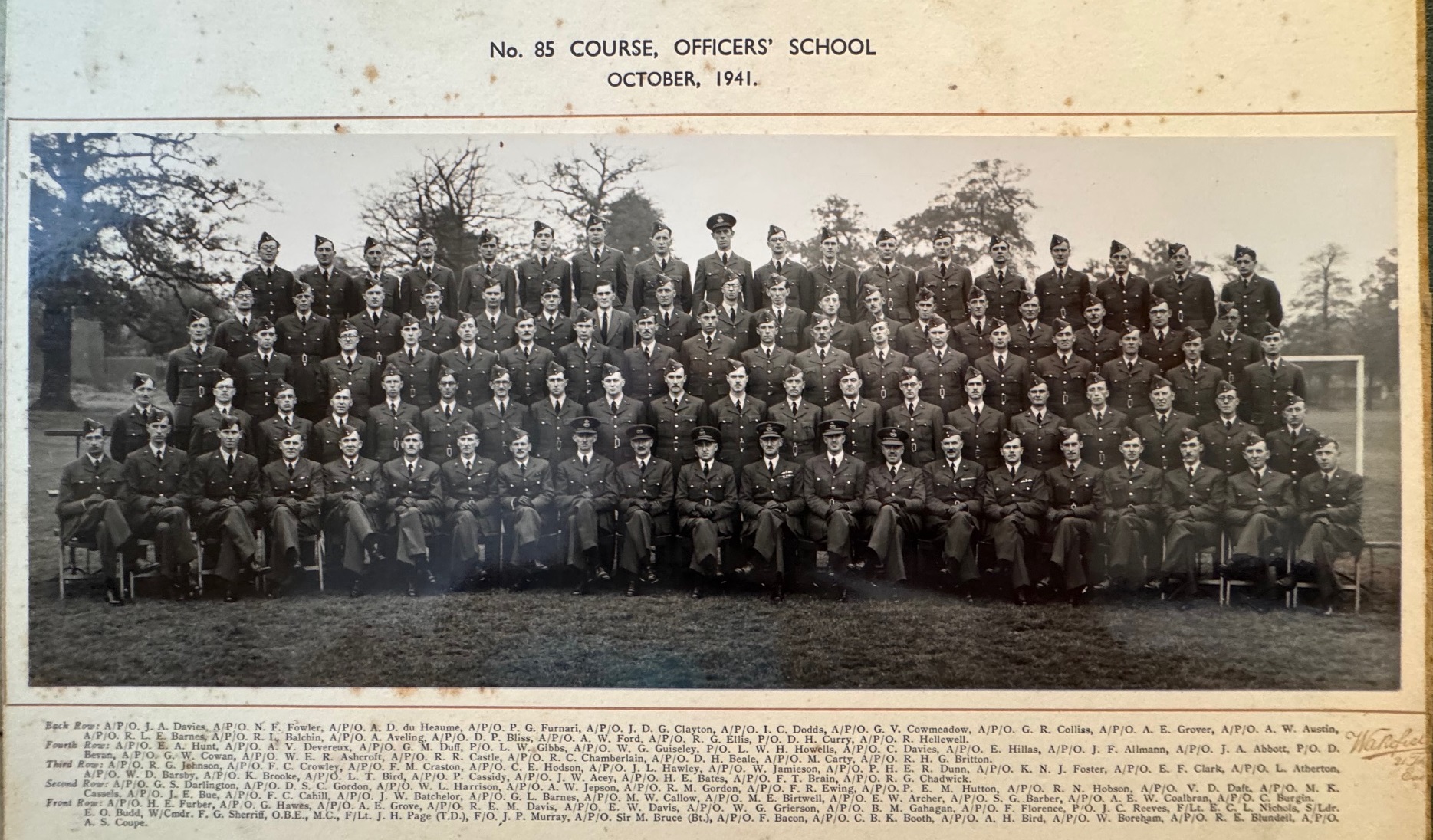
This was formed on 1 June 1940 at Loughborough in No 20 Group, replacing the Officers' Disciplinary Course, which had been running there since 1 March. The course was to be of three weeks duration with an intake of 45 per week up to a maximum of 135. From 22 July 1940 two additional hostels were taken over, permitting the capacity of the school to be raised to 240 officers under instruction. It was transferred to No 24 Group at some point.
It moved to Uxbridge on 11 July 1941, being transferred to No 27 Group, where the courses continued to be of three weeks duration but the intake was raised to 200 per week up to a capacity of 600. It was redesignated No 1 Officers School on 1 February 1942.
 |
|
Officers of No 85 Course, Officers' School - October 1941. photo courtesy Ross Boardman (whose Great Uncle Arthur du Heaume is on back row, 3rd from left) |
No 1 Officers' School
This was formed from The Officers' School on 1 February 1942 at Uxbridge and moved to Cosford.on 15 June 1942 where it was amalgamated with No 2 Officers' School into the RAF Officers' School
It reformed from the Aircrew Officers' School on 1 May 1946 at Hereford and disbanded on 15 January 1947.
No 2 Officers' School
This was formed on 1 February 1942 at Cosford in No 20 Group to provide refresher training to officers of all branches up to the rank of Flight Lieutenant in General Service subjects. Each course was of three weeks duration comprising an intake of 60 officers. It amalgamated with No 1 Officers' School to form the RAF Officers' School on 15 June 1942.
Officers School of Instruction
This was formed in October 1918 at RN College, Greenwich moving to Halton House, Halton Camp on 6 January 1919 and disbanded on 9 August 1919.
No 1 Officers' Technical Training Wing
This was formed from No 1 OTT Corps on 1 January 1917 at 119 Marina Street, St Leonards on Sea being placed under No 1 Area on 1 April 1918 and on in June 1918.
No 2 Officers' Technical Training Wing
This was formed from No 2 OTT Corps on 1 November 1917 at Hastings being placed under No 1 Area on 1 April 1918 and on in June 1919.
No 3 Officers' Technical Training Wing
This was planned to form on 3 October 1917 at Hastings but formation did not proceed.
Polish Air Force Staff College
This was formed on 1 March 1943 at Black Barony Hotel, Eddleston in Scotland as a section of the Deputy Inspectorate General of the Polish Air Force, Blackpool, parented by No 929 Squadron. Each course was 8 months in duration for 20 students per course.
It moved to Weston-super-Mare in April 1944 and disbanded on 30 April 1946.
RAF Chaplains’ School (Church of England)
RAF College
RAF College Air Squadron
This was formed on 1 April 1992 at Cranwell, to provided elementary flying training to officer cadets destined for pilot training, its task being taken over by No 1 EFTS on 11 July 2003.
RAF Officer Cadet Training Unit
This was formed on 10 September 1953 at Jurby, as the RAF OCTU (Jurby). It was retitled RAF OCTU on 1 April 1954 and absorbed the WRAF OCTU on 3 January 1962. On 1 September 1963 it moved to Feltwell, then to Henlow on 1 May 1956, being transferred from No 22 Group to HQ Training Command on 1 December 1971 its disbanded on 24 April 1980 with all officer training being transferred to the RAF College, Cranwell.
RAF Officers School
This was formed from No 1 Officers' School and No 2 Officers' School on 15 June 1942 at Cosford in No 20 Group and was redesignated Officer Cadet Training Unit on 1 May 1946.
RAF Regiment Officer Cadet Training Unit
This was formed on 1 August 1942 at the Knowle Hotel, Sidmouth in No 20 Group, administered by the Medical Training Establishment and Depot. It was transferred to No 72 Group on 12 October 1942, with the last intake commencing training on 17 February 1943 and disbanded on 31 March 1943.
However, it had been reformed at Catterick by 15 September 1947 when it was transferred to the functional control of the RAF Regiment Central School, no further details at present.
Secretarial Officers School
This was formed on 1 July 1960 at Spitalgate in No 22 Group and moved to Upwood on 16 September 1964, where it disbanded the same day on being absorbed into the establishment of RAF Upwood.
RAF Staff College
RAF Staff College, Bulstrode Park
RAF Staff College, Bracknell
RAF Staff College, Andover
RAF Staff College (Overseas)
RAF Technical College
This was formed from the RAF School of Aeronautical Engineering on 15 August 1947 at Henlow. It absorbed the Empire Radio School, Debden on 20 October 1949 and was divided and renamed as follows: -
Henlow
HQ RAF Technical College
Henlow Division, RAF Technical College
Debden
Debden Division, RAF Technical College
On 1 June 1953, HQ, RAF Technical College was disbanded and the Henlow Division, RAF Technical College was renamed the RAF Technical College, assuming Group status of HQ, RAF Technical College. It merged into the RAF College on 1 January 1966.
RAF Technical College (Armament Division)
This was formed on 16 December 1949 at Lindholme and disbanded on 15 November 1950.
RAF Technical College (Debden Division)
This was formed from the Signals Division, RAF Technical College on 24 February 1951 at Debden and disbanded on 8 April 1960.
RAF Technical College (Henlow Division)
This was formed on 24 February 1951 at Henlow and was renamed RAF Technical College on 1 June 1953.
Royal
College of Defence Studies
South-Eastern Area School of Instruction
This was formed in November 1918 at St Leonards-on-Sea. and disbanded on 21 January 1919.
Technical Officers School of Instruction
This was formed on 1 April 1918 at Henley-on-Thames, moving to Halton on 7 January 1919 and disbanded on 12 April 1919.
18th Wing School of Instruction
This was formed on 22 September 1916 at Hendon and disbanded in September 1918.
WAAF Officers Cadet Training Unit
Originally a Section of the WAAF Officers' School at Windermere it became a separate unit on 1 July 1944, when the WAAF Officers School moved to Stratford-upon-Avon, with a capacity of 150. It disbanded on 12 October 1945.
It reformed on 30 June 1948 at Hawkinge, initially to accept a single course of 24 cadets on a 12 week course.
WAAF Disciplinary School
Opened on 11 August at Grove House, Reading under No 26 Group to provide a short one week disciplinary course to WAAF Code and Cypher Officers, with a weekly intake of 40 trainees. The last course in Reading began on 2 November 1940, after which the school moved to Bulstrode Park, Gerrards Cross, which it completed on 20 November 1940 and was transferred to No 24 Group. It was renamed WAAF Officers' School on 17 April 1941.
WAAF Officers School
This was formed from WAAF Disciplinary School on 17 April 1941 at Bulstrode Park, Gerrards Cross. From 1 May 1941 the fortnightly intake was increased from 40 to 80 and it moved to Loughborough on 26 July in No 27 Group. At this point it was running four courses, as follows: -
Initial Course, promoted from the ranks - duration 2 weeks
Initial Course, direct entry - duration 4 weeks
Administrative Course - duration 2 weeks (later extended to 3 weeks)
Staff Course - duration 2 weeks
It moved to Windermere on 26 October 1942, until 1 July 1944 when the bulk of the school moved to Stratford-upon-Avon, leaving the section known as the WAAF Officer Cadet Training Unit at Windermere. The new course programme was as follows: -
| Course | Length | Intake | Peak | 1st Intake at Stratford | |
| No | Frequency | ||||
| WAAF Officers Admin 'A' | 4 weeks | 40 | 4 weeks with 1 week's break after every 2nd Intake | 40 | 19 Jul 1944 |
| WAAF Officers Admin 'C' | 4 weeks | 40 | 2 weeks with 1 week's break after every 4th Intake | 40 | 19 Jul 1944 |
| Instructors' Course | 2 weeks | 10 | 2 weeks with 1 week's break after every 3rd Intake | 10 | 19 Jul 1944 |
|
Total |
90 | ||||
It moved to Stoke Orchard on 12 November 1944, after which its fate is unknown.
Its formation was announced in Air Ministry Order A350/41 dated 15 May 1941: -
A350 - The WAAF Officers' School
The following courses of instruction are to be given at the WAAF Officers' School.
Initial course - For all newly appointed WAAF officers. Duration fourteen days.
Administrative course - For officers holding WAAF administrative appointments. Duration fourteen days.
Staff course - For specially selected WAAF officers.
Any other WAAF officers' course for non-technical training as may be required.
All WAAF officers on first appointment will undergo the initial course.
The selection of officers to undergo the administrative course and the staff course will be made by the Air Ministry (WAAF Postings).
Officers attending either the administrative or the staff course will be attached to the WAAF Officers' School and will return to the parent unit on completion of the course.
The following instructions are applicable to all officers attending the school
Officers attending the initial course are to obtain a single railway warrant and officers attending other courses are to obtain a return railway warrant to Gerrards Cross Station, GWR, before leaving their unit.
Officers attending courses referred to in sub-paras (ii), (iii) and (iv) of para 1 above should bring with them for use during instruction a copy of KR & ACI and the Manual of Air Force Law, if available.
Officers are to report to the school at Bulstrode Park, before 1600 hours on the date ordered for assembly of the appropriate course.
A form of dress suitable for physical training should be included in kit.
Results of courses are to be promulgated in the following manner
Form 292 is to be prepared in duplicate only. The original is to be forwarded to the Under-Secretary of State, Air Ministry (T Admin.).
The duplicate is to be forwarded to the group headquarters (or command headquarters where applicable) of the parent station of each officer reported upon. After scrutiny at group headquarters this copy is to be passed to the parent station for retention.
A consolidated record
of Form 292 in respect of each course is to be maintained at the WAAF
Officers' School, and a copy is to be forwarded to Headquarters, No. 24
Group.
[Photos and Personnel Memoirs | Photo of Course No 50]
WRAF Depot
This was formed on in July 1947 at Hawkinge and was redesignated WRAF OCTU on 1 June 1960.
WRAF Officer Cadet Training Unit
This was formed from the WRAF Depot in No 22 Group on 1 June 1960 at Hawkinge and disbanded on 3 January 1962 on being absorbed into the RAF OCTU, Jurby.
WRAF School of Instruction
This was formed from the WRAF Depot on in September 1919 at Hampstead, London and disbanded on 15 September 1919.
This entry was last updated on 21/01/26